
 By Anne-Marie Green
Director of Communications, NETRF
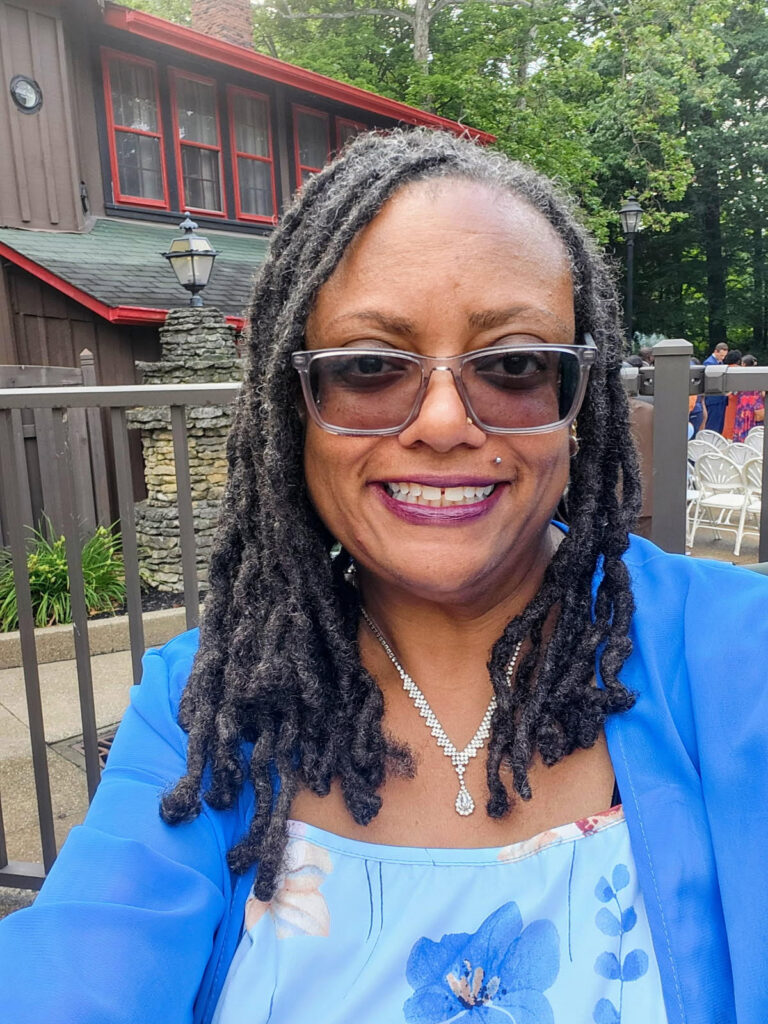
Based in Columbus, Ohio, Tawnisha Jones has spent 11 years as a senior outpatient coder at the Ohio State University James Cancer Hospital. She has read through countless charts, coding surgeries and visits across every type of cancer. “There’s no cancer that’s the same,” she says, echoing her hospital’s own slogan. “And I see that reading the charts.”
What she didn’t expect was to discover that truth along her own health journey.
A Diagnosis Buried in Routine Tests
In July 2025, a colonoscopy revealed neuroendocrine tumors (NETs) in Tawnisha’s small intestine. Looking back, the signs had been building for a while. She was anemic, and her doctors couldn’t explain why. She was exhausted in a way that didn’t make sense. She had abdominal pain that was hard to pin down. “They wanted to pinpoint exactly where the abdominal pain was,” she recalls. “And I said, ‘It’s all over. I’m just not feeling myself.’”
She had also been managing gastroesophageal reflux disease GERD since 2007 and was only recently able to come off the medication she’d relied on for nearly two decades. A hernia surgery followed the diagnosis, and in the middle of her recovery, another doctor diagnosed her with Crohn’s disease, a condition whose symptoms can overlap with neuroendocrine cancer.
At first, when it came to her NETs diagnosis, she was told “don’t worry about it.” The tumors were small. They were slow growing. They were likely benign. But reassurance without real answers didn’t sit well with her. “No ma’am, I’m worried about it,” she remembers thinking. “You’re waiting for the boogeyman. Something’s happening, something’s coming. Are they telling me I need to just wait around and see what happens?”
Learning to Advocate for Herself
For about a year, Tawnisha describes herself as “blind,” unsure of what to do or who to turn to. She was cycling through specialists, including a blood specialist, while dealing with constant diarrhea, nausea, and vomiting severe enough that her blood counts dropped and she needed 48-hour hospital stays and blood transfusions.
Everything shifted when she found a NETRF conference through a Facebook support group she’d joined right after her diagnosis. “I just started researching, reading people’s comments and questions,” she says. “They were the ones telling me, be your own advocate. Go see this specialist. Get this. Get that. That really helped me.”
Attending NETRF’s NET Impact conference in Ohio in May 2026, with her mother by her side, gave her the language and the confidence to push further. Soon after, she saw a NET specialist, who ordered a PET scan and confirmed the tumors were small and Stage 1. On July 31, he removed three of them. Now, she’s cleared from routine visits with her NET specialist and continues follow-up care with her gastroenterology team.
“It’s okay to say to your primary, I value your opinion, but I would love to have a second, or third opinion, whatever you need,” she says. “That’s what I do in patient Facebook groups now. I tell people to self-advocate. Don’t just accept what one doctor says. Get a specialist, somebody that knows what they’re talking about. That needs to be re-told constantly, from the new patients all the way to the longer-term ones.”
Finding Guidance and Community
Beyond the medical guidance, Tawnisha found something she hadn’t expected: community. “There was not a sad face in that conference,” she says of NET Impact. “Everybody was very nice to talk to.” She met patients who had been living with neuroendocrine cancer for one year, for fifteen years, and for twenty. Through the conference, she connected with NETRF’s Director of Patient Education Jessica Thomas, a relationship she still values. “That’s how I met Jessica, just the networking of it all. I really love that.”
She also learned practical things she hadn’t heard before, like which foods to avoid to better manage her symptoms. “I didn’t know to stay away from seeds and things like that.” Since adjusting her diet, she’s lost 25 pounds, a meaningful shift for someone also managing diabetes.
Living With Uncertainty, Challenges and Hope
Neuroendocrine cancer has touched every part of Tawnisha’s life, from her day-to-day routines to her relationships. She’s honest about how much there is to carry at once. “It’s a lot mentally that you have to deal with,” she says.
Still, she’s found a way forward, rooted in research, community, and self-compassion. “I just want to continue researching and get to know what this is,” she says. “That way I won’t be so scared of it. It does help to know that somebody is out there researching and getting some answers, understanding it, and figuring out how to treat it. I want that to keep going.”
Her hope for the future is simple and direct: that scientists and researchers keep working toward a cure. “If they don’t, who will?”
Her advice to other patients, especially those newly diagnosed, is just as direct. “Give yourself grace. Everything is coming at you at once, and you’re thinking, I’m not doing enough. But give yourself grace. And part of that grace is being your own self-advocate.”
____________________________________________________________________________________________________________________________________________
Patient Stories
Advancing Understanding of Multiple Endocrine Neoplasia (MEN): A Q&A With John Metzcar