
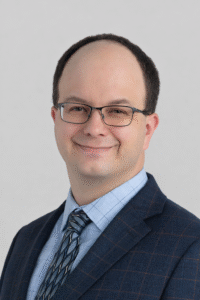
We recently spoke with John Metzcar, PhD, president of AMEND USA, neuroendocrine cancer patient and bioinformatics researcher.
Can you share a little bit about yourself and your background?
I wear a lot of hats. Professionally, I’m a cancer researcher at the Cleveland Clinic, where I focus on computational systems biology — specifically bringing mechanistic and statical modeling to questions on immunology, immune-oncology, and longitudinal biomarkers, all in cancer patients. I just joined the Clinic after a great postdoc at the University of Minnesota, and both have been incredible opportunities to work alongside world-class scientists on problems that really matter to patients. Also, it’s been an interesting start. I recently had lung surgery for a bronchial neuroendocrine tumor (NET) and am in the middle of PRRT with accompanying unexpected leave. I had surgery at the beginning of my postdoc as well! Taken together, this seems to support the “wearing multiple hats” theory.
In terms of academic background, I hold a dual informatics and engineering PhD from Indiana University. Working with two departments was, to put it mildly, not the most straightforward path. But it brought together my love of math, computers, and biology in a way that’s shaped everything I do now and I’m better for it. I also have a background in winemaking, of all things.
What are MEN disorders and how did you become involved in the MEN community?
Multiple Endocrine Neoplasia (MEN) is a group of rare, inherited genetic syndromes characterized by the development of tumors in multiple endocrine glands. It’s a super power! But for growing tumors, a super power no one wants. There are four identified subgroups: MEN1, MEN2a, MEN2b, and MEN4. Each number has a different mutated gene: MEN1, RET (both MEN2a, and b), and CDKN1B. MEN1 and MEN2 have a prevalence of 1/20,000 – 1/30,000 (less for MEN2b) and MEN4 is very rare (1/1,000,000 or less).
While my family and I were originally diagnosed with MEN1 in the late 2000s, my life really changed when I was diagnosed with metastatic pancreatic neuroendocrine tumors (PanNETs) in 2017. At the time, I was a first-year PhD student with a young daughter, and I was quite scared. I started treatment with somatostatin analogs and eventually moved to everolimus, which I was on for several years.
Around that same time, there was a call for volunteers at AMEND USA, a support, education, and advocacy organization for people with multiple endocrine neoplasia disorders. I responded to the call to find meaning and community during this incredibly difficult period. Luckily the organizational leadership was very welcoming, and I found that community and purpose I had hoped for. Over time, as other volunteers moved on, I became one of the more involved members, and in 2020 I became president of the board.
What is AMEND USA, and what is its mission?
AMEND USA is a patient-centered non-profit advocacy organization. We were founded in 2012 through a collaboration with AMEND, a fantastic organization currently led by Jo Grey. While we are independent organizations, we proudly share a strong partnership, including branding, mission, and governance. Now is a good time to recognize Jo’s amazing mentorship of me and other organizational leaders. Her leadership and impacts for the MEN community are truly remarkable.
AMEND USA has a two-fold mission. First is patient empowerment through education and community development. People with MEN disorders often have to tell their story in depth every single time they see a new provider, because the disease isn’t widely understood even among clinicians. Also, it’s a syndrome, a cluster of conditions, and patients often struggle to be treated as a whole person. We want to change that by making sure patients have the information they need to advocate for themselves and navigate their care with greater ease and peace of mind with support from the patient and caregiver community.
Second, we’re also active supporters of research. We serve on consortia, write letters of support for grants, and work to connect patients with researchers and clinical trials. It takes everybody — patient organizations, pharmaceutical developers, translational researchers, academic clinicians, quality of life researchers, etc — working together. I could go on and on about this. I really believe in the NCATS translational spectrum concept of biomedical work; it takes us all working cooperatively across disciplines to advance understanding and the standard of care. As part of this, AMEND USA seeks to connect like-minded folks. We can’t do it all and don’t want to. Let us each contribute in our own best way!
Finally, AMEND USA is just on the cusp of setting out more specific scientific and research goals to focus our research efforts. We, of course, look forward to working with NETRF and others to accomplish these goals!
What has your experience as a patient been like?
Everolimus worked for me, which I’m grateful for. But I want to be honest: it was hard. There were stretches where my mouth hurt so much that it was all I could do just to speak. Obviously, each person will have their own experience, but I lived on peanut butter and jelly sandwiches and avocado toast for a whole summer because they were soft enough to eat. Also, if you are experiencing such impactful side effects, tell you care team rather than toughing it out. That’s all part of the collaborative effort of the patient and care team. I wish I had made that move sooner.
What struck me as a researcher, though, was learning that we still don’t have a reliable biomarker to predict who will respond to everolimus. My oncologist essentially told me: it works for some patients, we don’t know why, and we find out by giving you the drug for six months and then scanning you. We have clues, but they are only clues, not conclusions. That troubled me deeply, both as a patient living through the side effects, and as a scientist. We can do better. It also led to me joining the informatics department to look at cell signaling networks.
How do you want to see the research progress for the MEN and neuroendocrine cancer communities over the next five to ten years?
I want to see more researchers directing their curiosity toward MEN disorders and learning from them to help the sporadic population. Taking the menin gene product as an example, there is just so much we don’t know about its place in the functional and signaling networks within a cell. Also, patients with MEN are followed for a long time because they can live a long time and are often identified early. That makes them an incredible resource for longitudinal research. I think we’re just beginning to scratch the surface of that data! Many centers have long-running MEN cohorts. Many researchers have models, data, and interest! And if we come together, we are even stronger; collaboration and data and knowledge-sharing are a must in these and any rare diseases!
Personally, I’m most interested in the “watch and wait” paradigm for non-functional pancreatic NETs in MEN1 patients. We’re still primarily using criteria from around 2012 to decide when to intervene surgically and yet roughly half of patients who undergo a distal pancreatectomy or Whipple procedure still recur to the liver. I’m an example of that. If we can use longitudinal modeling and biomarkers to better predict who’s at risk and when to intervene, we can make those decisions with far more precision and spare patients from surgeries that may not be necessary or catch those who will recur before it’s too late. I’d put it under early detection, which is why I was so excited to see the recent NETRF RFA! I am also interested in advancing preventative medicine in the MEN population. We know we are going to have problems. Can we stop them before they start with immune training on pre-cursor lesions? Can this, combined with early detection, stop disease spread in sporadic populations as well?
What would you like to say to researchers who might be considering MEN-related work?
There’s funding available, and it’s an exciting time. I’d encourage researchers to submit MEN-related grants applications to NETRF and other funding agencies. There are people who want to support this work. Beyond impacting the MEN patient community, learning the biology of the disease is not only fascinating and studying these patients likely has broad applicability for NETs and other diseases. These connections are completely unexplored but ready for work! We don’t even know how this knowledge will impact understanding and outcomes! We need to explore more!!.
Both AMEND USA and myself are also actively looking for collaborators and partners at the clinical and basic research level. And while we are not necessarily the right folks for every project, we have a good chance of knowing who is. Reach out! That’s how this field grows.
What has this community meant to you personally?
It’s given me purpose. When I was first diagnosed, it felt like everything lacked form and there was just a void of information and huge personal uncertainty and anxiety. Finding this community, and being welcomed into it, changed that. It has taken something devastating and given it meaning. And its just been a source of fun, friendship, and support that I never expected! I learned so much from all the generous community members – from healthcare providers to scientists to patients. It’s like having a second family! And thanks to all who attended my crazy computational-based dissertation defense! That meant the world to me!
_____________________________________________________________________________________________________________________________________________
John Metzcar is president of AMEND USA and a researcher at the Cleveland Clinic.
AMEND will host an online town hall for anyone interested in MEN and a support group for those directly impacted by MEN disorders on August 31, 2026. Register now to join the session.