
By Anne-Marie Green
Director of Communications, NETRF
Erik Mittra, MD, PhD, is the Section Chief of Molecular Imaging and Therapy at Oregon Health & Science University and a member of NETRF’s Board of Scientific Advisors. He has worked in neuroendocrine cancer for about 15 years, starting with the NETTER-1 trial. We recently spoke with him about his research, his hopes for the field, and the joys of biking.
Tell us about your background and your current role.
I’m at Oregon Health & Science University in Portland, where I’ve been since 2018. I came here to be the Section Chief of Molecular Imaging and Therapy. Before that, I spent eight years at Stanford University, where I also did my residency and fellowship in Nuclear Medicine.
How did you enter the field of neuroendocrine cancer research?
I got started in the field through the NETTER-1 study. I was a junior attending physician at Stanford and wanted to get more involved in clinical trials. DOTATATE imaging was new to us at the time, and we were learning the field as we went. My co-investigator in Oncology was Dr. Pamela Kunz, and she helped introduce me to the world of neuroendocrine tumors (NETs).
That’s also where I came to really enjoy therapies and theranostic clinical trials. Therapy is an integral part of Nuclear Medicine today, but when I entered the field it was a smaller part of the work, which was mostly imaging. The field’s origins are actually in therapy, with treatments for hyperthyroidism and thyroid cancer. Over the decades it shifted toward imaging, which is why Nuclear Medicine in the US largely sits within Radiology, while in much of the world it is its own specialty.
What is your lab working on?
We call it the ATOMIC lab, short for Advanced Theranostics and Molecular Imaging Collaborative. It’s a group of clinicians, medical physicists, and scientists who each have their own research projects. Most of our work focuses on improving the radioligand therapies we deliver. For example, we focus on dosimetry and other approaches that could make these therapies more personalized and hopefully more effective.
My own focus is mainly on theranostic clinical trials. That includes investigator-initiated studies, retrospective studies, and several databases tracking patient outcomes. The goal across all of it is to improve our imaging and therapies for better patient outcomes.
How did you get involved with NETRF?
Dr. Anna Greene, NETRF’s Chief Scientific Officer, reached out to me. I’ve been part of the neuroendocrine cancer community for about 15 years and have worked with many different groups. A lot of my colleagues know NETRF through its research grants, but since my work centers on clinical trials, that wasn’t my path. NETRF was always on my radar, though.
How has your experience been on NETRF’s Board of Scientific Advisors?
Great, both with NETRF in general and with the board. It’s a fantastic group of researchers and clinicians who are engaged, supportive of one another, and focused on the best outcomes. I’ve served on a number of scientific advisory groups in this field, and this is one of the better run and better organized ones. Anna Greene does a great job leading both the research programs and the BOSA, and the organization as a whole has been a pleasure to work with.
What do you enjoy doing outside of work?
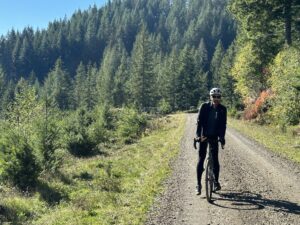
Cycling has been a central part of my life. I’ve done long endurance rides for most of it. I did my first century ride, 100 miles, when I was 18 and never looked back. Over the last 10 years I’ve gotten more into gravel biking, which is a fast-growing sector of the sport.
For those of us who are unfamiliar, what is gravel biking?
It’s in between road and mountain biking. Mountain biking is more technical, with fat tires, suspension, and often a lot of downhill. Gravel is more like forest roads, usually something you could drive on, but out in the woods. There’s much less traffic, the scenery is always beautiful, and you’re out in the wilderness.
It’s also harder than road riding, so you get a better workout in less time. A 100-mile road ride isn’t easy, but a 100-mile gravel ride is very challenging. Most routes mix in some pavement. You might start from home or a parking lot, ride a stretch of road to reach the gravel, and go back and forth from there. Some routes are entirely gravel.
You recently took a cycling trip to Italy. Tell us more.
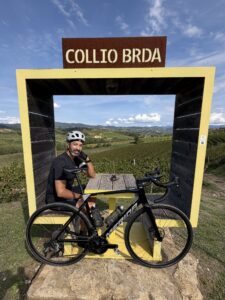
In the last five years or so, I’ve started taking cycling trips around the US and abroad, mostly gravel but some road. This one was a road trip to northern Italy. We were based in Cormons, about an hour and a half north of Venice by train, in the Friuli wine region. It’s full of vineyards, a bit like Napa but with different grapes.
Cormons is only three miles from Slovenia, so every day we rode through both countries. There’s no border patrol, just a sign telling you whether you’re in Italy or Slovenia. These trips usually run 20 to 70 miles a day for five days. That’s a lot for me now, since I don’t have as much time to ride as I’d like. I’m a typical weekend warrior.
How do you balance it all?
People who know me well say I do a pretty good job with work-life balance. I love my work, the people I work with, and the other things I’m involved in, like NETRF. But I try to get some exercise every day. That’s my goal. Sleep is the other piece. My big discovery during the pandemic was how much of a difference good sleep makes.
What are your hopes for the future of neuroendocrine cancer research?
Over the last 15 years I’ve seen tremendous growth. When I started, therapeutic options were limited, and so was imaging. Since then, treatment options have grown across the board, not only in nuclear medicine. It’s wonderful to see all these options for patients.
We’re still learning. Over the next 10 to 15 years, I’d love to see that growth continue: a deeper understanding of the biology, progress on neuroendocrine carcinoma, which remains a clear unmet need, and a better understanding of radioligand therapies and how to sequence treatments. There are so many ways we can keep improving the lives of our patients.
________________________________________________________________________________________________________________________________________
Learn more about NETRF’s Board of Scientific Advisors and our 2026 group of research grantees.