
By Carrie Camino, Member, NETRF Board of Directors
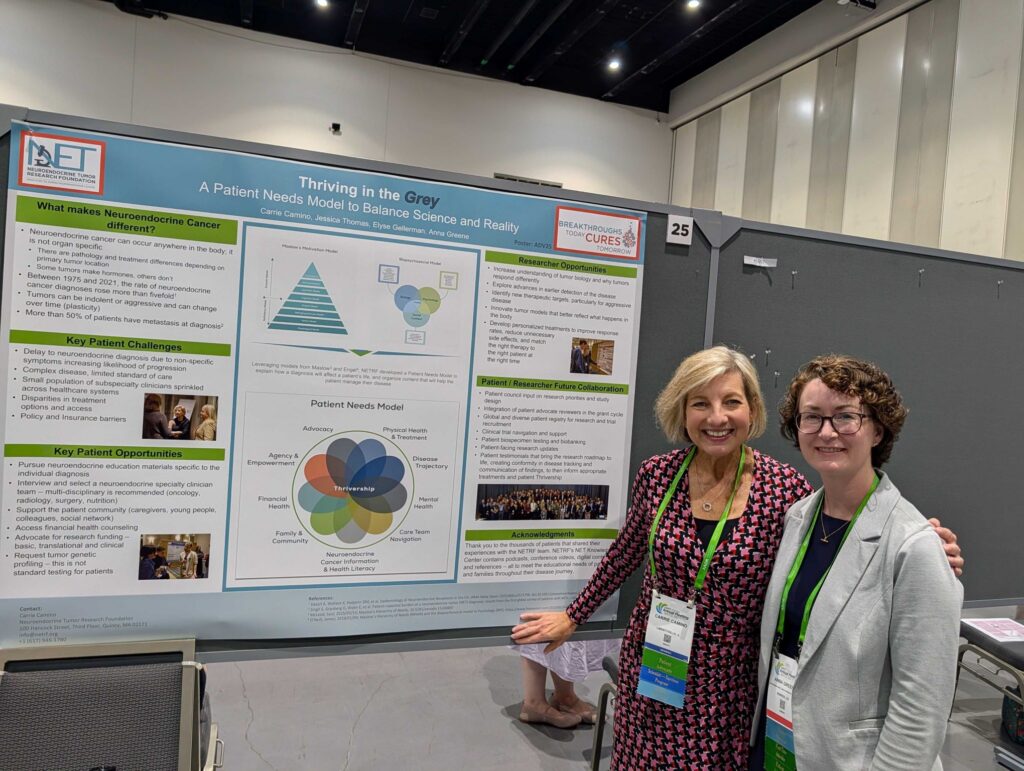
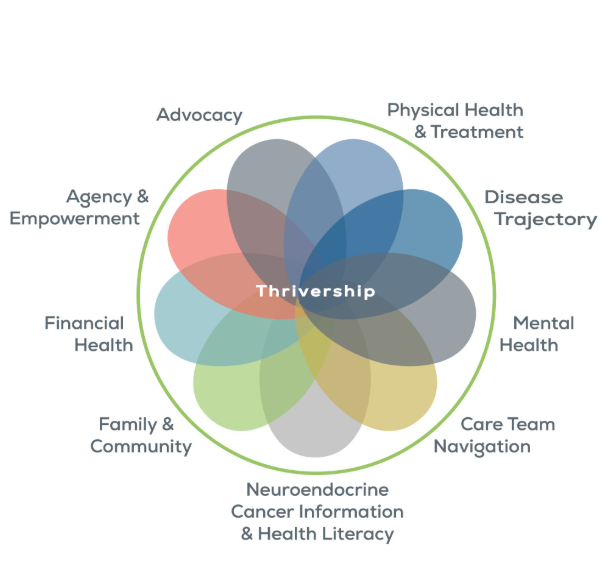
Last month I had the extraordinary opportunity to attend the American Association of Cancer Research (AACR) as part of the Scientist↔Survivor Program 2026. I was one of 42 patient advocates selected to attend a series of cancer research lectures led by leading-edge researchers to educate and inspire action in support of cancer patients. Additionally, I was asked to share my perspective based on my experiences as a neuroendocrine patient and my role as a member of the NETRF Board of Directors. To support this, I prepared for the conference by creating a poster with NETRF colleagues describing a thrivership (the state of knowing what you need to thrive after cancer treatment) and patient education model. Then, during the program, my team of fellow cancer advocates and I were asked to apply the principles of cancer evolution (and evolutionary theory) across biological, spatial, and temporal scales to transform patient outcomes. No small task! But, we eagerly took up the challenge and enjoyed presenting our perspective with researchers.
Coming out of the AACR, a few key points have stayed with me as I think about thrivership for neuroendocrine cancer patients, and how, as a patient and board member, I can advocate for better outcomes.
Embracing Resilience
Cancer is one of the most “complex, adaptive systems” in nature. Recent studies show cancer’s fascinating ability to morph at the cellular level to best take advantage of where it lives and to avoid treatment therapies, including changing into a different type of cell altogether. These cellular changes flow through a predictable evolutionary process, and targeting specific cell types may allow us to slow or prevent mutations, or intentionally steer cancer cells towards a treatable path. Researchers are focused on the mechanisms of resilience and “survival of the fittest” at the cellular level, and are starting to turn their learnings into improved therapies.
As a neuroendocrine cancer patient, living in the gray of not knowing what physical changes my cancer will cause next is stressful – mentally and physically. Most folks best thrive with some level of consistency. Neuroendocrine cancer patients are inspiring for our ability to tap into our own complex, adaptive natures, and pull together a sense of structure for ourselves to reduce our stress. Perhaps it’s an exercise routine or incorporating a favorite recipe once a week. Anything that brings joy and gently quiets the noise of what’s happening with your body can foster well-being. As we anticipate the next big research discovery, let’s applaud the everyday things we do to add a little bit of “known” back into our lives and increase our own resilience.
Changing our Treatment Approach
The approach to cancer treatment is evolving. What researchers have discovered is that aggressive, overtreatment causes cellular mutation because the tumor evolves to survive in its changing environment. Many times upon a cancer diagnosis, the initial response is to cut, burn or freeze out the tumor in an attempt to “cure” the patient. For neuroendocrine patients, these approaches and others must be part of a nuanced conversation with clinicians to select the best approach. Current thinking is to evolve therapies that control the cancerous growth, with a strong focus on high quality of life during treatment.
As a neuroendocrine cancer advocate, treatments that include a continuous focus on living a rich and fulfilling life are key. Neuroendocrine cancer is a chronic disease, and solutions need to be something that are folded into our daily routines. Researchers want patient input so they know how their discoveries are improving patient lives, not just treating disease. I encourage patients to share their personal definition of thrivership in discussions with providers, participation in clinical trials, and engaging in research-focused activities. These are valuable contributions towards better therapies.
Inspiration for Thrivership
I was inspired by the sheer depth and breadth of the researchers and professionals attending the AACR – over twenty-three thousand brilliant and passionate people all dedicated to solving the cellular puzzle that cancer presents. Researchers are at a pivotal point in understanding the factors that cause a cancer tumor to evolve and how to reduce the risk of mutations occurring. Further, they are finding new interventions and working to prove out clinical toolsets, leveraging AI where practical. Their quest to find high quality-of-life solutions was evident in every corner, allowing me to breathe with renewed hope and a strong sense of urgency.
As a NETRF board member and donor, I chose to get involved and contribute my talents to help fund new scientific discoveries. My work to support research efforts and share my voice on thrivership is a key part of my cancer journey, because encouraging this approach changes lives. Researchers want patient input so they know how their discoveries, such as biomarkers and precision therapies, are improving the patient experience, not just treating disease. Patients sharing their thrivership approach shape quality of care and drive overall health.
Neuroendocrine cancer can feel terrifying. But, coming out of the AACR, I am inspired to re-imagine this disease with a thrivership mindset – 1. I received a diagnosis, 2. I am managing symptoms with treatment and lifestyle changes, and 3. I share my experiences to help researchers and patients. Sometimes it feels unreal, but I am not just surviving cancer, I am living a rich and fulfilling life. In sharing my AACR experience, I am sending my fellow patients encouragement and support for getting closer every day to their own true thrivership.
_______________________________________________________________________________________________________________________________________________________
A View from AACR: Keeping Neuroendocrine Cancer in the Conversation