
Jamie Metzl is a writer and technology/health care futurist who regularly speaks to the medical industry on the future of health care. When Jamie’s father, Kurt Metzl, was diagnosed with pancreatic neuroendocrine cancer in 2022 at the age of 87, Jamie became his primary healthcare decision-maker, navigating the disease alongside his father, a pediatrician and Holocaust survivor who was determined to confront the disease.
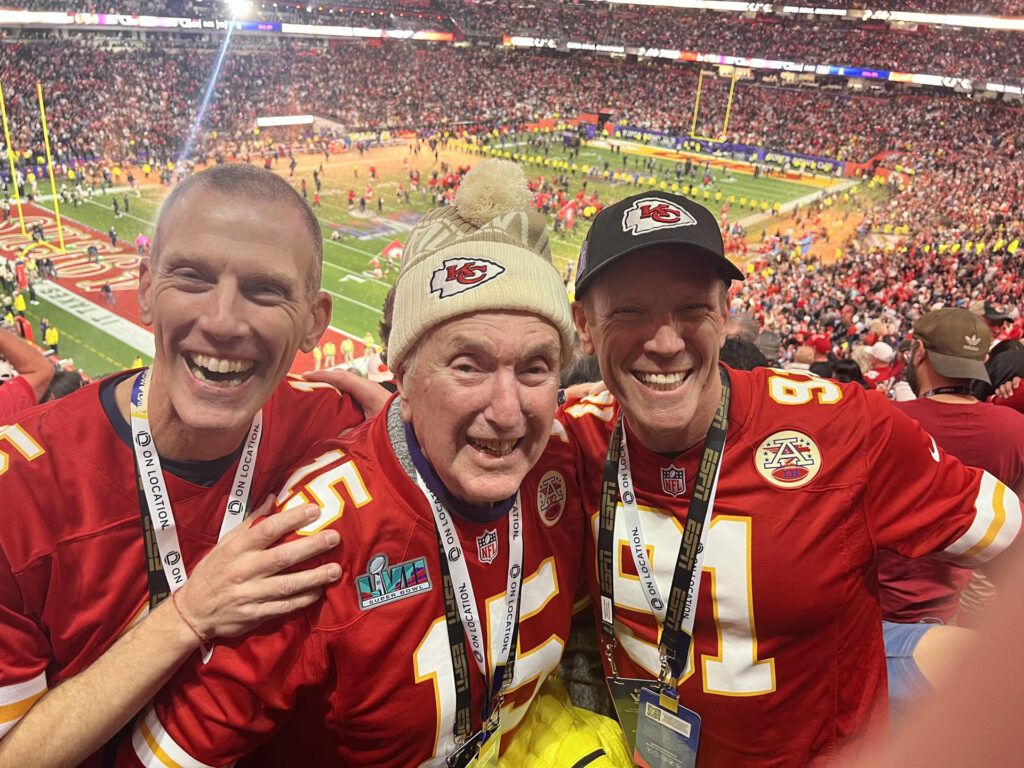
Kurt died in April 2025, but thanks to innovative treatments, he was able to enjoy several personal and family milestones in the nearly three years after his diagnosis. Jamie was inspired to share their story in a recent issue of AARP magazine, along with a 15 Point Battle Plan for cancer patients and caregivers. He credits NETRF resources as invaluable during this journey and recently spoke with us about his unique experience as both a healthcare expert and a caregiver.
Q: Were you familiar with neuroendocrine cancer before your father’s diagnosis?
A: Barely. I mean, most people think that Steve Jobs died of pancreatic cancer. So I knew a little more than many people, in that I knew Steve Jobs had neuroendocrine cancer. I know a lot about health systems and human biology, but I didn’t know more about neuroendocrine cancer than any other kind of cancer.
Q: How did you approach learning about the disease?
A: I immediately contacted Cancer Commons, and my contact person there talked me through some of the basics, like the difference between pancreatic neuroendocrine cancer and pancreatic cancer. I’m a learner, and my first instinct is always just to dive in. So I immediately found the resources on the NETRF website invaluable. I’m also an ultra-marathon runner, with a lot of time on my training runs, so I basically listened to most of the NETWise podcast series, which were fantastic, during my runs. That really helped break it down into digestible bits and helped me understand what the different treatment options were on a much deeper level. I also attended every single oncology visit with my father, either in person or via FaceTime from New York to Denver.
Q: How aware of neuroendocrine cancer was your father’s care team?
A: Very. He was at a high-level academic institution with a fantastic oncologist, and I also had a contact at Mass General Hospital. But as the patient’s representative, I needed to educate myself to avoid being the weak link, because the patient or their representative really needs to know a lot to navigate this very complex and complicated process.
Q: As someone with a neuroendocrine cancer diagnosis late in life, how did your father arrive at the decision to pursue treatment?
A: I said to my Dad, “You have two options.” One, there are many people later in life who say, “I’ve lived a great life. Cancer treatment is hard. I don’t want to be treated. I just want to let this play out.” I know my dad well enough to know that he wouldn’t want to do that, but I felt like I had to present that as an option.
The second option I presented was to be treated. As an expert on the future of healthcare systems, I was in an excellent position to help him seek out the most forward-looking care. I knew what my dad would say. He was a Holocaust survivor. His whole spirit was fight, fight, fight. So when he said, “Let’s fight,” those were our marching orders. That’s what we decided to do. Even as a physician for five decades, it was challenging for him to manage the decision-making on his own, so it was my honor to navigate this with my father. It allowed him to take a step back and focus on living life with less of a burden, other than being a partner in the big decisions.
Q: How did you decide which treatments to pursue?
A: My father outsourced most of that decision-making to me. After oral chemo (CAPTEM) failed, we faced a critical choice: FOLFOX (aggressive IV chemo, 30% success rate, harsh side effects) or targeted agent therapy based on his BRAF V600E mutation (only four cases in the literature). I pushed for the targeted therapy to prioritize lifestyle. That decision, driven by early sequencing, proved crucial. I wouldn’t have been able to make that decision if NETRF hadn’t made it feasible for me to learn so much so quickly, so I had an informed voice in what turned out to be probably the most critical decision we made throughout his treatment. And now there is a published study on pancreatic neuroendocrine cancer with a V600E mutation based on my Dad’s case.
Q: As an expert on the future of healthcare systems, what surprised you most as a caregiver?
A: The biggest challenge is that when you know the least and are in the greatest shock, right after diagnosis, you must make nearly all your most important treatment decisions. You’re required to learn faster than at any point in your life. If you miss that window, it’s hard to make up for it. You can still get great care for yourself or your loved one, but you are not as central to the decision-making process.
Q: How were NETRF resources helpful?
A: The podcast and website were huge. They brought everything together in a reliable, digestible way. I learned about PRRT, treatment decision trees, and all the options. It would have taken me an insane amount of time to gather that information myself.
Q: What’s your most important advice for patients and caregivers?
A: Right after diagnosis, you need to come up with a strategy. Get rolling immediately. If possible, assemble a team of family members to divide responsibilities. For patients, I’d recommend advocating to have your cancer genes sequenced as soon as possible. Use my 15-point plan from AARP magazine as a game plan.
Q: Should patients push providers to explore non-standard treatments?
A: Yes, but strategically. Be informed and collaborative with your oncologist. Having strategic, educated, positive patients actually helps the medical system.
Q: What makes you hopeful for the future of neuroendocrine cancer care?
A: Precision oncology, sequencing, targeted therapies, mass databases, and AI analytics are revolutionizing care. It’s never a good time to get a cancer diagnosis, but you have better odds today of beating cancer than at any previous time in history. Tomorrow, those odds will increase in your favor. Strategies from other cancer types now benefit neuroendocrine cancer patients, but patients and families must play a central role.
___________________________________________________________________________________
Explore our NET Knowledge Center, including our NETWise podcast, offering the information and resources you need throughout your neuroendocrine cancer journey.