Positive Results Reported from Phase 3 CABINET Trial
Positive results are reported from the Phase 3 CABINET trial evaluating the drug cabozantinib in advanced neuroendocrine tumors. Interim data shows significant improvement in progression-free

Positive results are reported from the Phase 3 CABINET trial evaluating the drug cabozantinib in advanced neuroendocrine tumors. Interim data shows significant improvement in progression-free

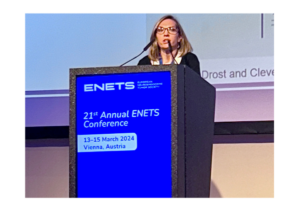
NETRF’s impact on neuroendocrine cancer research was evident at the 20th Annual European Neuroendocrine Tumor Society (ENETS) Conference, held March 22-24 in Vienna. The ENETS

Peptide receptor radionuclide therapy, or PRRT, has been available as a treatment option for some forms of neuroendocrine tumors – particularly for those NETs expressing the somatostatin receptor-2 (SSTR2) protein.

Dr. Po Hien Ear’s research involves growing NET spheroid clusters in large enough numbers to be used to screen the potential anti-tumor properties of hundreds of therapeutic compounds.

The Neuroendocrine Tumor Research Foundation (NETRF) has awarded $2.62 million in grants to advance research aimed at finding new and innovative treatments for neuroendocrine tumors

COVID forced NETRF’s annual Research Symposium to be held as a virtual meeting in November. Despite this change, the Symposium reached more researchers than ever

Early NETRF-funded research identifies a potential prognostic biomarker to help physicians predict neuroendocrine cancer outcomes.

NETRF’s Director of Research John Kanki, PhD, provides an update on the status of ongoing NETRF-funded research studies during COVID-19.

NETRF-funded research of miniature replicas of human organs is recognized with a Presidential Award for Basic Science at ENETS, a leading international meeting of NET scientists.

NETRF reports progress in the development of neuroendocrine tumor cell lines to help eliminate a decades-old obstacle in laboratory research. To stimulate progress in NET cell lines, NETRF established a Cell Line Prize, funded cell line research, and launched a collaboration with a nationally known research institute. Each of these initiatives has succeeded in establishing NET cell lines.