
By Anna C. Greene, PhD | NETRF Chief Scientific Officer
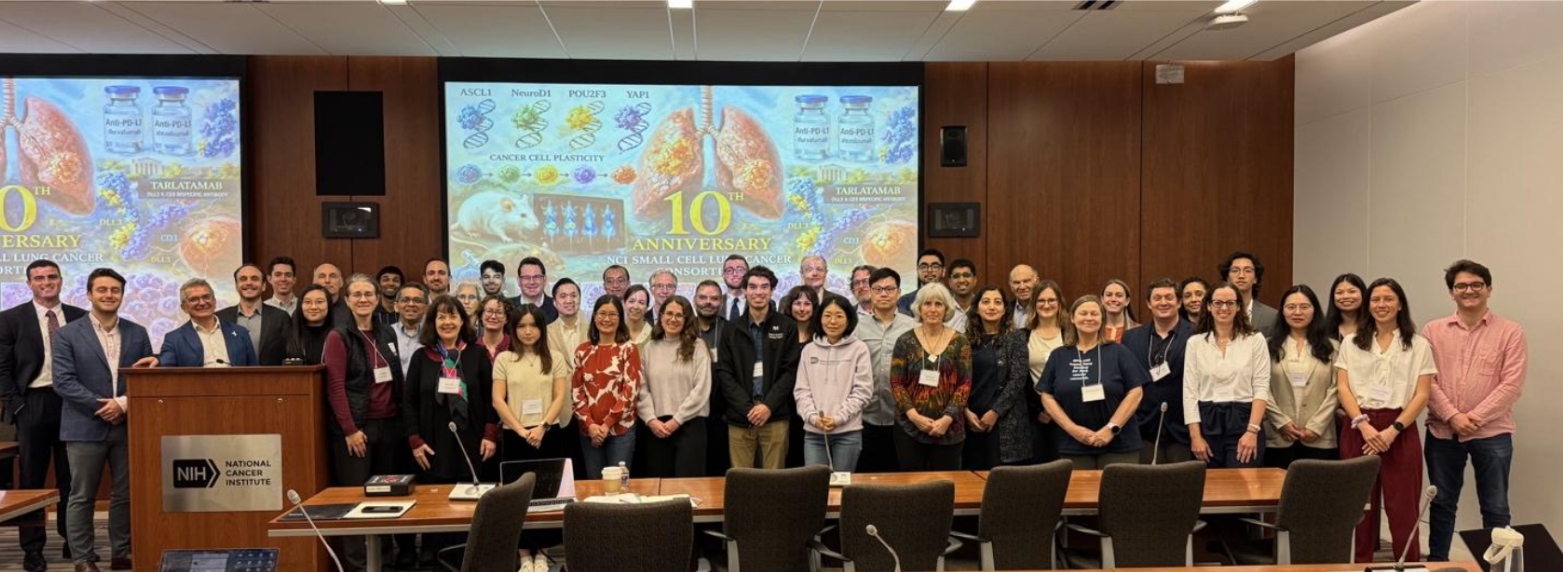
In May, I attended the 2026 Small Cell Lung Cancer Consortium hosted by the National Cancer Institute. During the meeting, I kept our NETRF community in mind: patients, families, clinicians, researchers, and donors, all working toward better answers for neuroendocrine cancers. Small cell lung cancer is its own disease, distinct from the neuroendocrine cancers many in our community know personally. But it is also a neuroendocrine cancer, and that connection makes it worth watching. Progress there can help all of us ask sharper questions, design better studies, and find better treatments for neuroendocrine cancers that start elsewhere in the body.
One of the biggest lessons from the meeting was that neuroendocrine cancer cells are not fixed. They can change their identity and behavior over time, and those changes may help them survive treatment.
A tumor can start out looking and behaving one way, then take on new features that make it less responsive to treatment. This may help explain a painful and familiar experience for patients: a treatment works for a while, and then it stops. In some cases, the cancer is not simply growing despite treatment. It is adapting to it.
This changes how we think about treatment resistance. We need to understand not only which treatment to use, but how the cancer is likely to respond, how it may change, and how we can stay a step ahead.
A second theme was that where cancer spreads may matter more than we once thought.
When cancer moves to the liver, brain, bone, or another organ, those sites are not just new addresses for the same disease. Each organ is its own environment. A tumor in the liver may face different pressures, interact with different neighboring cells, and respond to treatment differently than the same cancer growing elsewhere.
For neuroendocrine cancer research, this is a useful reminder to study tumors that have spread, not just the original tumor, and to build better tools for tracking how different sites of cancer in the same person behave over time. That matters most when biopsies are difficult, risky, or impractical to repeat.
A third theme, and one I found especially encouraging, was the immune system. Immunotherapy, a treatment that helps the immune system recognize and attack cancer, has been hard to apply to many neuroendocrine cancers. Researchers are now working to understand why some tumors stay hidden from the immune system, and whether certain treatments can make them visible.
This does not mean immunotherapy will work for everyone, or that there is a simple fix. It means the field is asking more precise questions. Instead of “Does immunotherapy work in neuroendocrine cancer?” we can ask, “Which tumors might benefit, under what conditions, and what combinations could help the immune system see the cancer more clearly?”
A fourth area of interest was a target called DLL3.
DLL3 is a protein found on the surface of some neuroendocrine cancer cells, particularly in certain higher-grade or more aggressive neuroendocrine cancers. Researchers are studying ways to use DLL3 to help find cancer cells and, in some cases, deliver treatment more directly to them. This is especially important because DLL3 is not necessarily present in every neuroendocrine cancer, and it may vary from person to person.
One promising approach pairs imaging with treatment. First, an imaging test shows whether a person’s tumors express DLL3. Then, for patients whose tumors have it, a therapy can deliver treatment directly to those cells. The approach is still evolving, but it reflects a broader shift toward personalized care: identifying the specific features of a person’s cancer and using that information to guide research, trial design, and, when appropriate, treatment.
Finally, the meeting reinforced the value of blood-based monitoring, sometimes called liquid biopsy.
A blood test will not replace everything we learn from tumor tissue, but it offers a less invasive way to follow cancer over time. It can reveal whether a tumor is changing, whether resistance is developing, or whether new types of cancer cells are emerging. For people whose disease is hard to biopsy repeatedly, this could become an important part of future research and care.
The broader message I brought home is one of connection. Small cell lung cancer research is moving quickly, and not every discovery will translate directly to every neuroendocrine cancer. We have to stay careful and rigorous. But we should also stay open to the possibility that progress in one neuroendocrine cancer can teach us something valuable about the others.
For patients and families, I know scientific progress can feel slow. But meetings like this show the field reaching a point where we can ask much more specific questions about neuroendocrine cancer biology: how these cancers change, how they interact with the body, how they evade the immune system, and how emerging targets could lead to more precise treatments.
I left with a stronger sense of urgency, but also with real hope. The better we understand the biology of neuroendocrine cancers, the better positioned we are to build smarter treatments, better monitoring tools, and new options for the patients who need them.